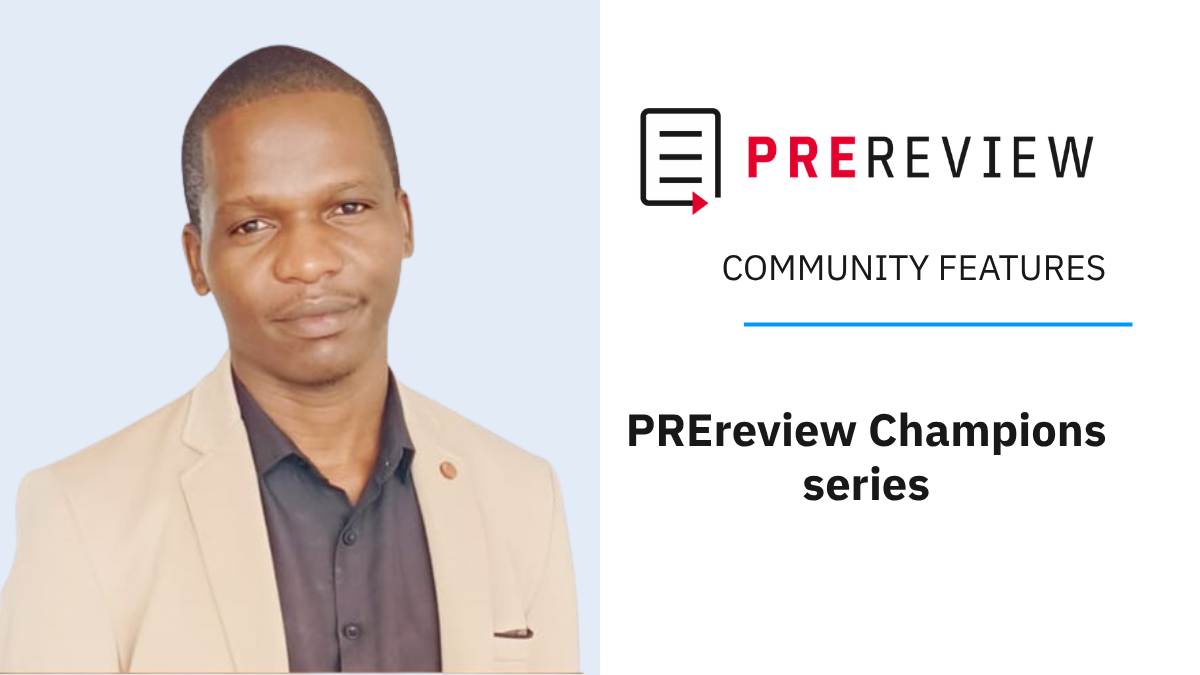
In this feature article, Akuma underscored the positive effect of the PREreview Champions Program on his confidence as a reviewer and facilitator, and on his commitment to open science, ethical scholarship, and inclusive research practices.
Why did you decide to apply for the PREreview Champions program?
I first learned about the PREreview Champions program through an email shared by Dr. Jennifer Miller, who leads the FORCE11 PREreview Club and encouraged me to participate. As a co-lead of this Club alongside Jennifer, I saw in the program an opportunity to strengthen my skills in open peer review facilitation while also contributing to a growing international community committed to improving research evaluation practices. I was particularly interested in learning how structured and constructive preprint reviews can enhance scientific dialogue, accelerate knowledge dissemination, and build researcher confidence. The program also offered a valuable platform for networking, mentorship, and capacity-building in open science advocacy.
I decided to apply for the program because I strongly believe in advancing equitable, transparent, and collaborative scholarly communication practices. My interest in open science and research integrity aligns closely with PREreview’s mission to democratise peer review and create inclusive opportunities for researchers, particularly early-career scholars and those from underrepresented regions.
How was your experience during the training part of the program?
My experience was highly enriching and intellectually engaging. The training exceeded my expectations in many ways by combining practical peer-review guidance with broader discussions of openness, inclusivity, research culture, and scholarly communication ethics. I appreciated how the sessions created a welcoming environment where participants from diverse disciplinary and geographic backgrounds could openly exchange perspectives and experiences.
One of my favourite aspects of the training was the collaborative review exercises, which allowed participants to critically evaluate preprints while receiving constructive feedback from peers and facilitators. These activities helped improve my confidence in providing balanced, respectful, and evidence-informed reviews. I also valued the emphasis on inclusivity and reducing barriers in peer review participation, especially for researchers from Low- and Middle-Income Countries (LMICs). The least favourite aspect was the challenge of coordinating across multiple time zones, which occasionally affected the convenience of participation. Nevertheless, the overall experience was highly rewarding and professionally impactful.
To complete the program, Champions have to organize and deliver their own engagement activities in their local communities. Tell us a bit about yours
As part of the PREreview Champions engagement activities, I co-led multiple PREreview Club sessions, where eminent professors, researchers, non-academicians, and postgraduate students conducted open peer review and preprint evaluation. The primary goal of the events was to encourage transparent peer review, constructive scholarly feedback, and strengthen participants’ confidence in critically appraising articles. The sessions were conducted virtually, with participants drawn from academic, research institutions, among others; particularly early and seasoned career researchers interested in research integrity and open science practices. Attendance was encouraging, with active participation throughout the discussions and collaborative review exercises. Oral feedback from participants was largely positive, as many appreciated the practical nature and opportunity to engage in peer review within a supportive environment.
A major takeaway from each session was the recognition that many early-career researchers are interested in open peer review but often lack information or mentorship opportunities. The PREreview club sessions reinforced the importance of community-driven learning spaces in promoting transparency, accountability, and inclusivity in scholarly communication.
What impacts do you think open peer review practices have on the scholarly communications landscape?
In my opinion, open peer review practices have the potential to significantly transform the scholarly communication system by improving transparency, accountability, collaboration, and trust in research evaluation processes. Traditional peer review systems are often criticised for being opaque, exclusionary, and sometimes susceptible to bias or gatekeeping. Open peer review increases visibility into the review process by encouraging constructive dialogue among reviewers and the broader society. This can improve the quality of reviews, promote scholarly accountability, and create opportunities for learning and mentorship, especially for early-career researchers.
Furthermore, open review practices support faster dissemination and refinement of scientific knowledge through preprints and community feedback. For researchers in LMICs, open peer review may also help reduce barriers to participation in global scholarly discussions by creating more inclusive and accessible platforms for engagement (like the PREreview club). However, successful implementation requires careful attention to reviewer protection, ethical conduct, respectful communication, and institutional recognition of peer review contributions.
Would you recommend participating in the PREreview Champions program to others?
Yes, I would strongly recommend participation in the PREreview Champions program, particularly for early-career researchers, graduate students, research mentors, and individuals interested in open science, research integrity, and scholarly communication reform. The program provides a supportive, collaborative learning environment where participants can develop practical peer review skills while engaging with broader conversations about transparency, inclusivity, and equity in research systems.
I believe the program is especially valuable for researchers from LMICs and underrepresented academic communities, where formal peer review training opportunities may be limited. PREreview Champions program helps participants build confidence in critically evaluating scientific work and contributing constructively to academic discourse. Additionally, the networking opportunities and international collaborations and mentorship (office hours, first Mondays on each month) fostered through the program can be highly beneficial for professional growth and interdisciplinary learning. I would say the program equips participants not only with technical review skills, but also with a deeper understanding of how open, community-centred peer review practices can strengthen the global research ecosystem.
One last takeaway?
Participating in the PREreview Champions program has been an inspiring experience that reinforced my commitment to open science, ethical scholarship, and inclusive research practices. One important realization from this journey is that meaningful transformation in scholarly communication requires collective participation, mentorship, and accessible training opportunities for researchers across all regions and career stages.
I am particularly encouraged by the growing global conversations around transparency, community-led peer review, and equitable knowledge production. Beyond PREreview, I remain actively involved in initiatives related to research ethics, AI ethics, public health research, and equitable digital health systems, particularly within LMIC contexts. I also hope to continue contributing to community-based peer review engagement activities that empower researchers to participate confidently and responsibly in scholarly evaluation processes. I believe programs like PREreview Champions are helping shape a more inclusive and collaborative future for academic publishing, and I look forward to supporting similar initiatives that promote openness, integrity, and shared learning in research communities worldwide.
Stay connected
If you have something to share or want to learn more about the Champions Program, drop us an email at community@prereview.org.
You can follow us on Mastodon, BlueSky, LinkedIn, and YouTube. You can also keep up with all the latest news by subscribing to our newsletter and joining our Slack community.
