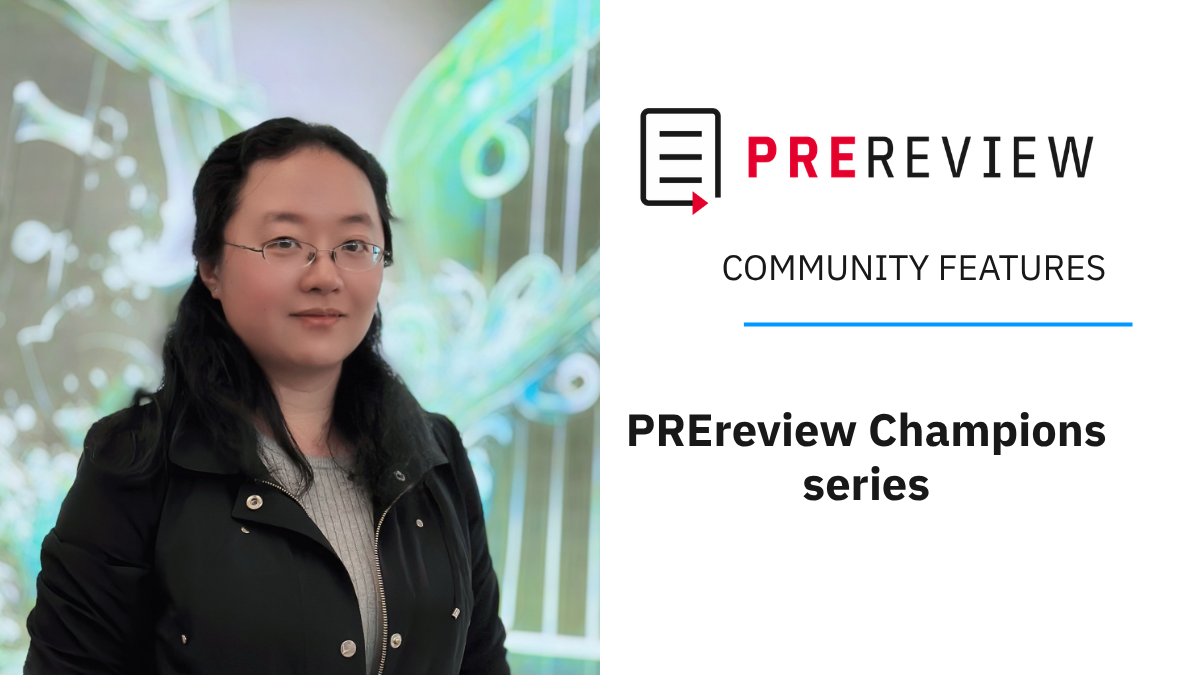
In this feature piece, Jade sheds light on the many potentials of open peer review, and envisions its intersection with open data to improve research evaluation and communication.
Why did you decide to apply for the PREreview Champions program?
I applied to the PREreview Champions program because I believe that open peer review can be a catalyst for a more transparent, reproducible, and community-centered scholarly ecosystem.
Over the years, I have had multiple conversations with friends and colleagues about how traditional journal-organized peer review can feel out of reach for many early-career researchers, with invitations typically going to more established scholars. Spaces like the ASAPbio Meta-Research Crowd and the FORCE11 PREreview Club have shown me a different model, one that is more collaborative, transparent, and intentionally designed to help people learn. Participating in these programs allowed me to review alongside others: seeing how different researchers approached the same manuscript broadened my understanding of rigor, constructive critique, and what it means to contribute to scholarly dialogue.
Becoming a PREreview Champion felt like a natural next step. I wanted to deepen my understanding of open and collaborative peer review and help introduce more researchers to these opportunities.
How was your experience during the training part of the program?
I really enjoyed the training sessions. It was great meeting the entire PREreview team and learning more about the thinking behind the organization’s work. As someone who talks to researchers about scholarly communication, I found it valuable to gain a deeper understanding of how PREreview fits within the broader movement towards more open and community-centered forms of scholarly communication and research evaluation.
I also appreciated the discussions around biases in peer review. The training acknowledges that bias is a normal part of being human and working within our current academic system. Rather than denying their existence and assuming we can be purely objective when reviewing a manuscript, we can try to recognize our biases and develop strategies to review more thoughtfully and fairly. I also appreciated how the PREreview team modeled intentional and inclusive language in discussing these topics, creating a learning environment that felt both welcoming and intellectually rigorous.
Another highlight was learning from my fellow Champions. We came from different countries, institutions, disciplines, and career stages. Hearing how peer review and scholarly communication were experienced in those different contexts made for some really thoughtful conversations.
To complete the program, Champions have to organize and deliver their own engagement activities in their local communities. Tell us a bit about yours
For my engagement activities, I designed and led two sessions as part of the UCSB Library’s Data to Discovery series: one focused on preprints and another on open peer review. The Data to Discovery series consists of 30-minute virtual workshops held every two weeks that introduce practical topics related to research data and open scholarship. For our Spring 2026 quarter, we decided to focus on sharing research openly, and discussions of preprints and open peer review were natural fits.
When planning these sessions, I intentionally avoided trying to cover everything. Instead, I focused on questions early-career researchers often ask: Should I post a preprint? What does open peer review look like in practice? How can someone get involved?
The response from participants was incredibly encouraging. Participants consistently described the session as relevant for their work and expressed interest in learning more. For me, that was one of the most rewarding outcomes. Preprints and open peer review can sometimes feel like niche topics within scholarly communication, so it was exciting to see researchers engage with these ideas and think about how they might apply them in their own contexts.
The experience also reinforced my appreciation for short-format programming. Thirty minutes is not enough time to provide a comprehensive overview, but it can be enough to spark curiosity, lower barriers to entry, and help someone take a first step toward deeper engagement.
What impacts do you think open peer review practices have on the scholarly communications landscape?
I think one important, sometimes overlooked, impact of open peer review is its role in reviewer training. I joined an ASAPbio Crowd Preprint Review Club during my postdoc, and it helped me build my confidence as I pivoted to the field of open science and meta-research. Reviewing alongside others allowed me to see different approaches to evaluating a manuscript and helped demystify a process that can feel intimidating early in one’s career.
Open review reports also become part of the scholarly conversation rather than remaining hidden behind editorial systems. When reviews are public, readers can see how different researchers interpret the data, what questions were raised, and where disagreements arose. In some ways, this makes science look more like what it actually is: an iterative process in which knowledge is refined through discussion and critique.
Perhaps most importantly, open and collaborative peer review lowers the barrier for communities to participate. Something as simple as transforming an existing journal club into a preprint review club can create new opportunities for early-career researchers to engage with peer review, learn from each other, and contribute to the scholarly record in ways beyond journal publications.
Would you recommend participating in the PREreview Champions program to others?
100%! One reason I found the PREreview Champions program so valuable is that it encouraged me to think beyond the mechanics of research and consider the system that shapes how research is communicated and evaluated. During my scientific training, I spent a lot of time learning how to conduct experiments, analyze data, and communicate results. I rarely had the opportunity to discuss questions such as: Why does peer review work the way it does? Who gets to participate? How might these systems evolve?
The Champions program created space for these conversations and provided practical guidance on engaging with researchers and. Anyone curious about preprints, peer review, or the future of scholarly communication would likely find the experience rewarding, just like I did.
Before we wrap up, is there anything else you’d like to share?
One other factor that initially drew me to the Champions program this year was PREreview’s partnership with Dryad to support dataset review. Part of my work in the Research Data Services department of the UCSB Library involves supporting researchers in sharing their datasets in Dryad. I was curious about how peer review of datasets might complement the curation and quality-control process already provided by data repositories.
Recently, I had the opportunity to participate in a collaborative dataset review through the FORECE11 PREreview Club, co-led by Dr. Jennifer Miller and fellow PREreview Champion Akuma Ifeanyichukwu. Our review is the first dataset review posted on PREreview. Moreover, the experience challenged me to think more deeply about what makes a dataset reusable and how researchers evaluate evidence that is not packaged in research articles.
I find this area particularly exciting because it expands our understanding of what counts as scholarly contributions. Combining open data with open peer review strengthens transparency across the research lifecycle; it also helps elevate datasets as research outputs worthy of discussion, critique, and recognition in their own right.
Stay connected
If you have something to share or want to learn more about the Champions Program, drop us an email at community@prereview.org.
You can follow us on Mastodon, BlueSky, LinkedIn, and YouTube. You can also keep up with all the latest news by subscribing to our newsletter and joining our Slack community.
