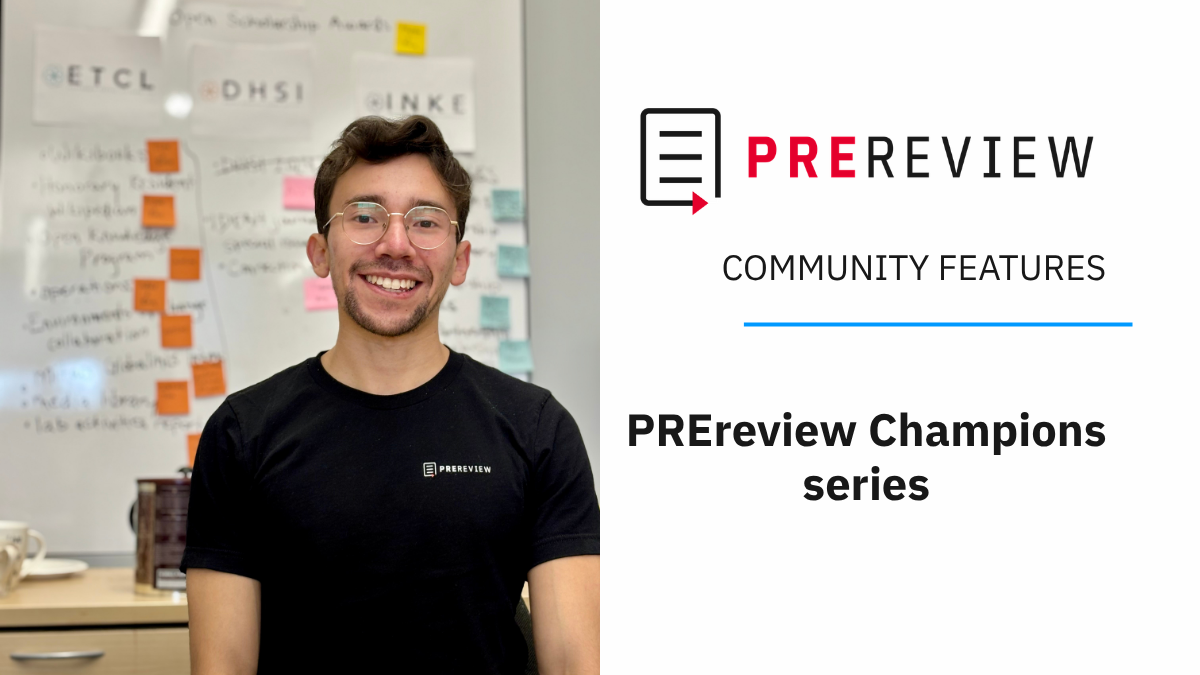
For this feature article, we spoke with Alan about his experience with the 2026 Champions Program and his reflections on open peer review practices.
Why did you decide to apply for the PREreview Champions program?
I was interested in the Champions program for several reasons. Although I had been learning about and researching open science for over four years, I hadn’t had much opportunity to engage with open peer review, so I thought the Champions program would allow me to learn more about this practice.
I only started doing peer reviews for a couple of digital humanities conferences last year and I found it to be a very gratifying experience, as it made me feel as though I were part of the scholarly community in my field. Although my first experience of being a reviewer was positive, I wanted to receive training in how to provide constructive feedback, and the Champions programme was a great way of gaining more experience and advice on writing reviews.
Another reason I applied to the program was to meet like-minded people who practice open science in their everyday work through preprints, open peer review, and more. There is a strong sense of community among the PREreview team and the other participants of the Champions program. It is great to be part of a community where openness is the norm and everyone recognizes the benefits of various aspects of open science.
How was your experience during the training part of the program?
The training sessions were a great way to start my day. I am in Victoria, British Columbia, Canada, so I was joining the sessions in the early morning when almost everyone else had already started work in other time zones. I liked that the training focused not only on how to use the PREreview platform or how to write constructive feedback, but also on discussions about power and social inequities in science. While I am used to these discussions in the social sciences and humanities, I appreciated that we were addressing these issues in a space with several STEM researchers.
I believe it is important to recognize how these inequities in science influence what science is produced, how it is done, and who gets to be a reviewer with the power to determine what constitutes high-quality science in a given field. The training also encouraged us to identify our own biases when reviewing papers, and to avoid letting these biases influence our reviews.
My only regret regarding the training was that I was not very familiar with the topic of the preprint that we reviewed during one of the Live Reviews. Therefore, I could not provide as much feedback as I would have liked. Nevertheless, it was valuable to hear the comments of others on the preprint and learn from them.
To complete the program, Champions have to organize and deliver their own engagement activities in their local communities. Tell us a bit about yours
I organized an online preprint Live Review on March 16, 2026 in collaboration with the Open Science Community of Victoria. Sixteen people participated in the Zoom session and we had a great discussion about a preprint titled “Symbolic Capital and Inequality in Scholarly Communication: A Bibliometric Study of Editorial Boards”.
Our participants were at different stages in their careers and came from a variety of roles. These included undergraduate students, librarians, faculty members, postdoctoral fellows and journal editors. Some participants told me that they enjoyed having the opportunity to reflect on a paper and discuss it with colleagues. These comments, along with my experience of leading the review, reminded me how enjoyable it can be to discuss a paper on an interesting topic with others. It was clear that the discussion participants cared about the topic of inequality in scholarly communication, and it was encouraging to see that some of them were considering how they could apply the insights from the paper to their own work as editors or researchers.
In your opinion, what are the impacts of open peer review practices on the scholarly communications landscape?
I believe that open peer review can increase transparency and trust in science by allowing readers to trace the entire process that a paper underwent before publication. The public nature of open peer reviews encourages more detailed and thoughtful reviews. Making reviews public also allows researchers to receive credit and recognition for all their reviewing work, which can take several hours per article.
Open peer reviews can also be a valuable pedagogical resource to teach graduate students how the journal publication process works and how to evaluate a research paper. Additionally, access to reviews of a journal of interest can help prepare a manuscript for submission by providing insight into what reviewers expect. This can help students to identify the (sometimes invisible) criteria used to evaluate papers in their field.
Finally, as someone who studies scholarly communication, open peer review provides an opportunity to analyze how knowledge is produced and legitimized. I have seen datasets compiling open peer reviews, and they are an interesting data source that opens the black box of peer review and allows researchers to analyze different aspects of it, including the underlying power relations.
Would you recommend participating in the PREreview Champions program to others?
Absolutely! I think it is a great program for graduate students and early-career researchers to expand their network and gain more confidence and skills in reviewing papers. The program could also benefit journal editors who are considering implementing open peer review and want to learn more about its advantages and how to implement it.
Looking ahead to…
I write for the Open Scholarship Policy Observatory, a blog that tracks trends in open social scholarship. As part of my work for the Champions program, I will have a post about open peer review published on the site in the next few months. Additionally, we also publish content on other topics that may interest the PREreview community, such as open access, multilingualism, and open science policies. We invite you to take a look!

Stay connected
If you have something to share or want to learn more about the Champions Program, drop us an email at community@prereview.org.
You can follow us on Mastodon, BlueSky, LinkedIn, and YouTube. You can also keep up with all the latest news by subscribing to our newsletter and joining our Slack community.
