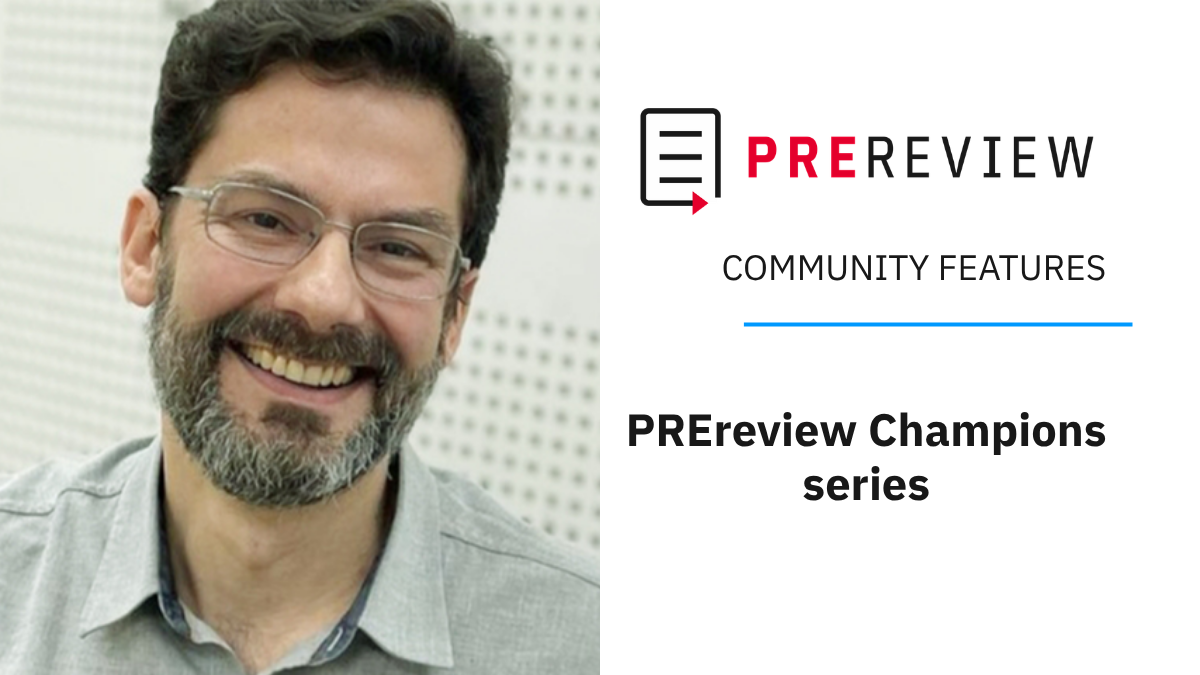
For this feature article, Carlos shared his main takeaways from the 2026 Champions Program and his understanding of open peer review as a means for community-building and mutual learning.
Why did you decide to apply for the PREreview Champions program?
I decided to apply because my academic and editorial work has increasingly led me to reflect on how peer review could become more transparent, inclusive, and constructive. As Editor-in-Chief of the Journal of Physical Education (Maringá), as a board member of the Brazilian Association of Scientific Editors (ABEC), and through my involvement with the Brazilian Reproducibility Network (RBR), I have been closely engaged with debates on research assessment, editorial quality, and Open Science.
The program seemed to offer a valuable opportunity not only to deepen my understanding of open peer review, but also to explore practical ways of fostering these discussions within my own academic and editorial communities in Brazil.
How was your experience during the training part of the program?
My experience was very positive and definitely met my expectations. I appreciated how the program combined conceptual reflection with practical guidance in a very supportive and collaborative environment. It was not only about understanding open peer review in theory, but also about thinking carefully about how to discuss and implement it in real communities.
My favorite moments were the exchanges with participants from different backgrounds, because they reinforced the idea that peer review is not just a technical procedure, but also a social and educational practice. The most challenging part was balancing the training with my regular responsibilities as a journal editor, researcher, and organizer in other Open Science initiatives. Still, it was a very worthwhile experience.
To complete the program, Champions have to organize and deliver their own engagement activities in their local communities. Tell us a bit about yours
For my engagement activity, I took part in a webinar on Open Peer Review organized by the Brazilian Reproducibility Network (RBR) with approximately 50 participants. The event created an important opportunity to discuss the challenges and possibilities of open peer review within the broader context of Open Science.
This activity was especially meaningful to me because it brought together different dimensions of my work: my role as Editor-in-Chief of the Journal of Physical Education, my participation in ABEC, and my involvement in RBR. The discussion showed that there is genuine interest in rethinking peer review not only as an editorial procedure, but also as part of a broader research culture centered on transparency, accountability, and participation.
One of my main takeaways was that these conversations become especially productive when they bring together editors, researchers, and students. Each group contributes a different perspective, and together they help make peer review a more open and discussable part of scholarly life.
What impacts do you think open peer review practices have on the scholarly communications landscape?
In my opinion, open peer review can have three major impacts. First, it strengthens transparency and accountability by making evaluation processes more visible and understandable. Secondly, it can broaden participation in scholarly communication by opening more space for dialogue across different career stages and positions. Lastly, and most importantly to me, it has a strong pedagogical impact.
Open peer review offers a very stimulating opportunity for students and early-career researchers to understand how science actually works in terms of evaluation, discussion, and circulation. Instead of seeing peer review as a distant or hidden procedure, they can begin to understand it as a formative process through which arguments are examined, criteria are negotiated, and knowledge is collectively improved.
From my perspective as a journal editor and as someone involved in ABEC and RBR, this pedagogical dimension is especially promising because it helps frame peer review not only as a selection process, but also as a learning and community-building one.
Would you recommend participating in the PREreview Champions program to others?
I would definitely recommend participating in the PREreview Champions program. I think it is especially valuable for journal editors, graduate students, early-career researchers, Open Science advocates, and people involved in research integrity or scholarly communication initiatives.
I would particularly recommend it to those who want to go beyond understanding open peer review conceptually, to bring these ideas into their own institutions, journals, associations, or research communities. For anyone interested in building more transparent, inclusive, and dialogical forms of scholarly communication, it is a very meaningful experience.
Before we close...
I would like to emphasize that participating in the PREreview Champions program reinforced my view that peer review can be much more than a filtering mechanism. It can also be a collaborative, educational, and community-oriented practice. That perspective resonates strongly with my work as editor of the Journal of Physical Education (Maringá) and with my broader involvement in ABEC and the Brazilian Reproducibility Network.
The program also reminded me that transforming scholarly communication does not depend only on major structural reforms. It also depends on creating spaces, conversations, and local initiatives through which researchers, editors, and students can engage differently with the culture of evaluation. For me, that is one of the most valuable contributions of PREreview: it helps connect the principles of Open Science to concrete forms of collective action.
Stay connected
If you have something to share or want to learn more about the Champions Program, drop us an email at community@prereview.org.
You can follow us on Mastodon, BlueSky, LinkedIn, and YouTube. You can also keep up with all the latest news by subscribing to our newsletter and joining our Slack community.
