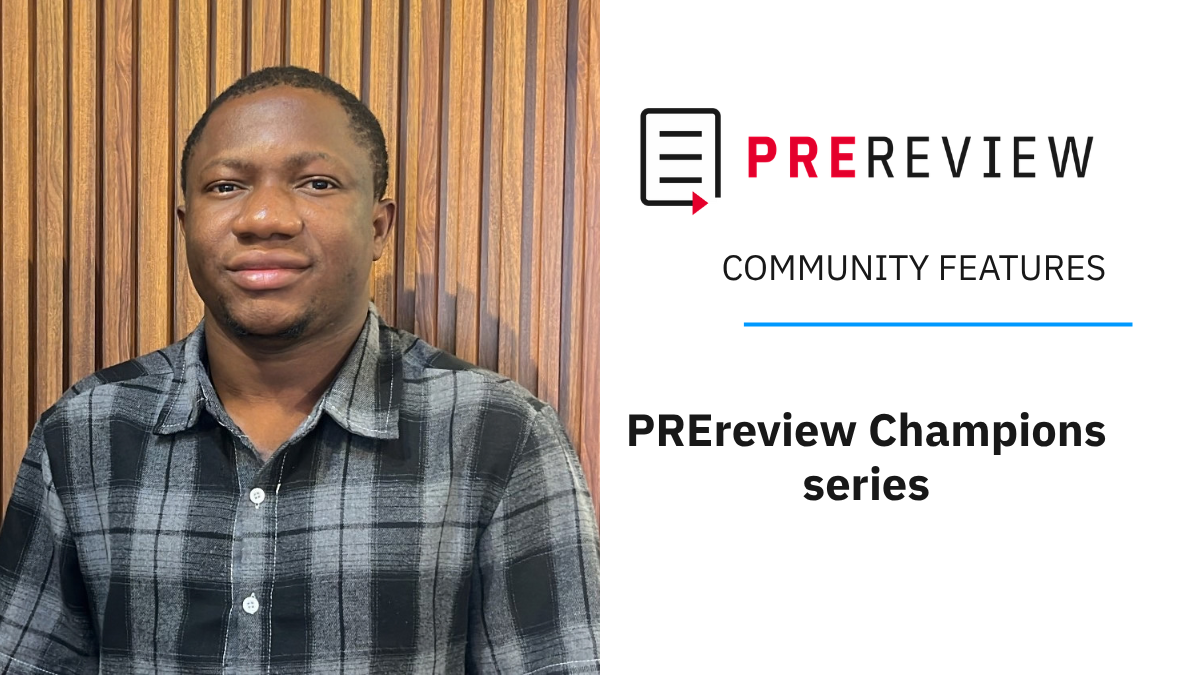
In the final issue of this series, Daniel shares his understanding of open peer review as a space for learning and confidence-building where students and ECRs are welcome to take part in, rather than put on the sidelines.
Why did you decide to apply for the PREreview Champions program?
Before applying, I had already reviewed manuscripts through the traditional journal-organized system, and had also published a review through PREreview. So I had seen the review process from both sides of the table: the closed, anonymous version, and the open, acknowledged one. That contrast is what pulled me in. Traditional peer review had taught me how to evaluate a manuscript, but it hadn't given me many chances to think about who actually gets to review, and who gets left out of the conversation altogether.
PREreview's open model answered a question I'd been sitting with for a while: peer review shouldn't be a closed room that only a small, established group has access to. I wanted to understand that model properly, and then bring it back to students and early-career researchers in my own network, most of whom had never been shown how review works, let alone invited to take part in it.
Applying for the Champions Program felt less like a leap, and more like a natural next step: a way to formalize something I already believed in, and turn it into something I could actively teach others.
How was your experience during the training part of the program?
The training went well beyond what I expected walking in. What stood out most was being introduced to PREreview's own methodology and approach to structuring a review, moving from the theory of open peer review into a practical, repeatable way of actually doing it. It reframed peer review for me as a skill that can be taught step by step, rather than something reviewers are simply expected to already have.
Sitting in on a Live Review session is what turned the training from an idea into a concrete framework. Watching a preprint get read and discussed openly, in real time, with the reasoning visible to everyone in the room, is something I've since made a point of trying to recreate in the sessions I lead. Every part of the training exceeded what I came in expecting, and the Live Review piece in particular is the one I will keep coming back to.
To complete the program, Champions have to organize and deliver their own engagement activities in their local communities. Tell us a bit about yours
I co-led two activities with other fellow Champions, and took a different seat at the table each time.
On June 20, 2026, we ran “Democratizing Peer Review: Empowering Early-Career Researchers through Open and Collaborative Science”, a webinar targeted to early-career researchers, students, and science enthusiasts across the wider African research community. My role there was mostly behind the scenes, moderating the session and coordinating the group, and it turned out to be its own kind of learning. Thirty people attended the call and, according to the post-event survey, their confidence in writing constructive reviewer comments had climbed from an average of 2.77 to 4.29 out of 5. Additionally, confidence in submitting to a preprint server went from 2.15 to 3.43, with all respondents saying they would recommend the session to a colleague. Watching that shift happen from the coordination side taught me something about myself I hadn't fully named before: program management is a skill I already carry into my career, and this activity is where I actually saw it in action.
On 25 July 2026, I took a front stage role for the event “Empowering Undergraduate and Postgraduate Students as Agents of Change in Peer Review,” opening the session myself with a talk on why peer review needs new voices, what a preprint is, and the practical PREreview tools, Clubs, and Live Reviews that help a student write their first review with confidence. By the end of it, the sense that early-career researchers and students are qualified to take part in peer review had risen from 3.0 to 3.6 out of 5 in the post-event survey. The workshop was rated 4.4 out of 5 on average, and everyone who responded said they would recommend it.
The recording from the June 20 session, and both the recording and learning materials from July 25 are available online.
What impacts do you think open peer review practices have on the scholarly communications landscape in your country and region?
For a long time, the biggest thing holding many early-career researchers back from contributing to scholarly research in Nigeria wasn't a lack of ideas. It was fear: fear of rejection, and a quieter worry that their work simply wasn't “scholarly enough” to survive the kind of anonymous, high-stakes scrutiny traditional review is often built around. Open peer review chips away at that fear because the process becomes something people can watch, learn from, and eventually take part in themselves, rather than a closed room they're waiting to be let into.
I think that shift could open real avenues across Nigeria and the wider region: researchers who currently sit on the sidelines, worried about being harshly judged, coming to see open, constructive review as a way in rather than a gate to fear. It also changes how people relate to rejection itself; a review that explains its reasoning openly is easier to learn from than a verdict delivered in silence. None of that happens overnight, but every session we've run so far suggests the appetite for it is already there, especially among students and postgraduates who've simply never been shown that this door is open to them.
Would you recommend participating in the PREreview Champions program to others?
Yes, without hesitation, and I'd especially point it to students, postgraduates, and early-career researchers across Africa who are still finding their footing in scholarly publishing. What I'd emphasize to them is PREreview's structured, modular approach to review: breaking the process down into steps that can actually be taught and practiced, instead of assuming that reviewing is a skill you're supposed to already have. That's the part of the program that turns curiosity into confidence.
I'd also recommend it to anyone thinking about research communication more broadly, not just reviewers-in-training, because the Champions program teaches you as much about building community and running an engagement activity as it does about peer review itself. Coming from Nigeria and working alongside Champions from Sierra Leone in this cohort, I've seen how much value there is in comparing notes on what does and doesn't land in different settings. It's a program that rewards showing up as a beginner and leaving as someone who can teach others.
Before we wrap up, is there anything else you’d like to share?
The Champions program paired me with a mentor whose guidance made a real difference in how I moved through it, from shaping the engagement activities to thinking through what comes next. I won't go into all of that here, but I'd be doing that mentorship a disservice not to mention it at all.
What I'm most looking forward to now is staying close to Live Review sessions, since that's where the learning I described earlier actually turns into practice, and continuing to contribute to PREreview's community activities more broadly, whether that's future Champions cohorts, Clubs, or simply showing up to review preprints myself. Facilitating two sessions this year showed me there's real appetite for this kind of work across Africa, and I want to keep building on that momentum rather than treating it as a one-off program requirement. If anything, this is just the starting point.
Stay connected
If you have something to share or want to learn more about the Champions Program, drop us an email at community@prereview.org.
You can follow us on Mastodon, BlueSky, LinkedIn, and YouTube. You can also keep up with all the latest news by subscribing to our newsletter, and joining our Slack community.
