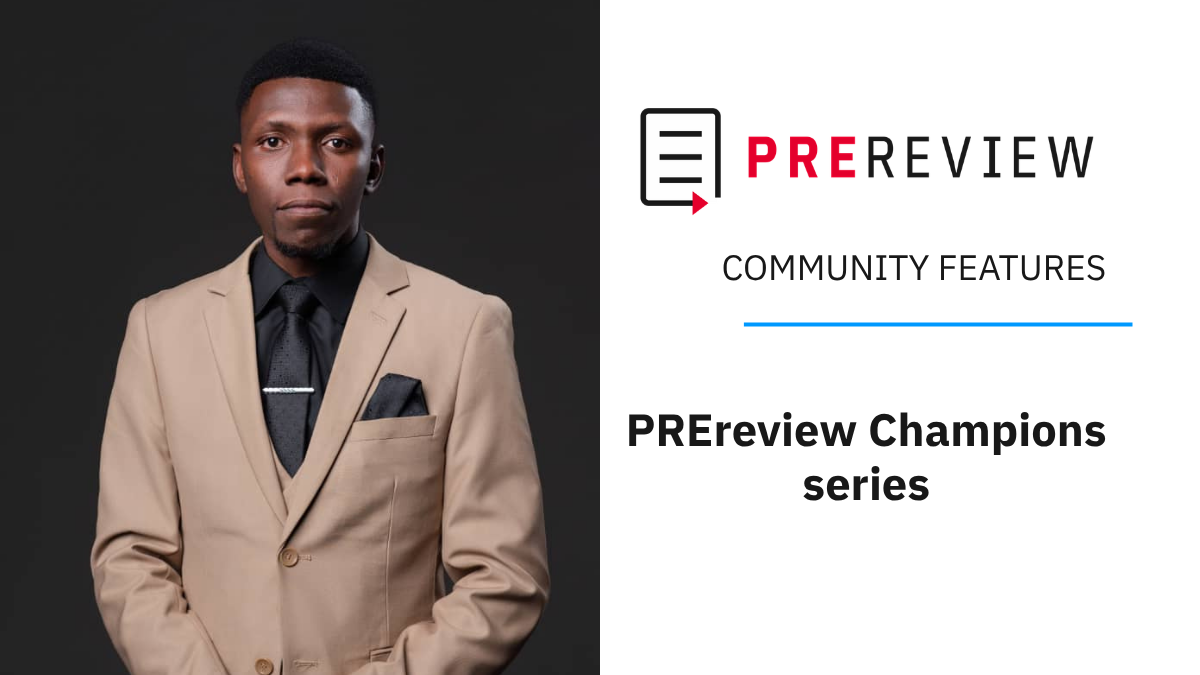
In this feature, Shitondo stresses out the importance of concentrating Open Science advocacy efforts in low-resource settings and educational institutions for a broader adoption of its principles and practices.
Why did you decide to apply for the PREreview Champions program?
Having been involved in the open science space for over a year at the time of my application, I saw the PREreview Champions Program as an opportunity to learn and develop skills that would strengthen my ability to advocate for and promote open science, particularly within my local context.
Open science serves to make the scientific process more equitable and transparent. Regardless of their background, researchers can make their findings more findable and accessible while contributing to the scientific process through preprint sharing and review. However, this alone is not sufficient. If we are to see open science widely adopted in line with the UNESCO Recommendation on Open Science, more advocacy is needed, particularly in low-resource settings.
How was your experience during the training part of the program?
My experience during the training was nothing short of awesome. I particularly appreciated how inclusive, respectful, and considerate the PREreview team and fellow Champions were. These were also some of the core principles emphasized throughout the program. My favorite moments were the catch-up calls, as they provided an opportunity to connect and engage with other Champions beyond the formal training sessions. I did not have any least favorite moments.
The level of engagement from both the Champions and the PREreview team was impressive, and I can comfortably say that the training met most of my expectations. I use the word “most” intentionally because I had also expected the training to cover some of the basics of open science and its underlying principles before moving into peer-review practices. I believe this could be particularly helpful for participants who are new to the open science space.
To complete the program, Champions have to organize and deliver their own engagement activities in their local communities. Tell us a bit about yours
I organized a virtual Open Research Symposium targeting undergraduate medical students at the University of Zambia. The symposium was held under the theme “Building an Open Research Culture Among the Next Generation of Scientists”, and it was also open to other undergraduate students in the health sciences, postgraduate students, and early-career researchers. The program comprised three sessions: (1) a webinar on Open Science and its Role in Research; (2) a webinar on How Students Can Contribute to Open Science; and (3) a hands-on workshop involving a live preprint review session.
We had over 140 people registering for the symposium. However, attendance varied across the sessions, with approximately 40–50 participants joining the first session, 17 joining the second, and 16 participating in the last one. The preprint review resulting from the Live Review session is available on PREreview, and the recording of the webinar about pathways for students engagement with open science can be downloaded here—using the passcode &@KP4fm#. The feedback we received was very positive, and a good number of participants subsequently joined the Review and Curate Network (RCN) community.
One of my main takeaways was the importance of effective communication and participant engagement when organizing virtual events. Although participants commended the initiative, attendance was one of the main challenges we encountered. Following a post-event review, we attributed much of this to the lack of a WhatsApp group, which could have allowed for quicker and more direct communication. Many participants missed reminders that were sent through email.
Overall, the experience taught me the importance of not only offering good content but also having an effective communication and engagement strategy to ensure that registrants actually participate.
What impacts do you think open peer review practices have on the scholarly communications landscape in your country and region?
Open peer review practices could encourage greater sharing of preprints, making research more visible and accessible. Many researchers experience long delays before their work is published because of the lengthy traditional journal peer-review process. Preprints can provide an opportunity for researchers to share their findings earlier while receiving feedback from the wider research community.
Secondly, open peer review could provide timely feedback that helps improve the quality of manuscripts before they are submitted to journals, potentially increasing their chances of acceptance.
Lastly, participating in open peer review can expand researchers' knowledge and strengthen their critical analysis skills, particularly when reviewing alongside people with different areas of expertise and experience. Open peer review is therefore not only about reviewing research, it is also a learning process.
Ultimately, these benefits could promote greater responsibility and accountability in scientific inquiry and communication while contributing to greater rigour and credibility in research.
Would you recommend participating in the PREreview Champions program to others?
Yes, I would definitely recommend the PREreview Champions Program to others. I believe there is a lot of work that needs to be done to promote open science, particularly within educational institutions.
In this regard, I would especially recommend the program to lecturers, researchers, and librarians, as they are directly involved in shaping research practices and have significant potential to influence policy and practice within their institutions. However, I would encourage anyone who has an interest in and commitment to promoting equitable and transparent scholarly communication to participate in the program.
Before we wrap up, is there anything else you’d like to share?
I currently work with the Review and Curate Network (RCN), where we promote open science in the Global South through preprint reviews and capacity-building programs, including webinars on research and open science practices.
As part of our activities, we conduct quarterly preprint reviews and publish them on the PREreview platform. We also have a podcast series where we invite people from different backgrounds to share their perspectives and insights on various aspects of open science.
There are several other programs and initiatives that we are currently organizing, and the network is open to anyone who would like to learn, contribute, or participate in promoting open science. People can connect with us through our social media platforms, including Facebook and LinkedIn, to learn more about our activities and upcoming initiatives.
Stay connected
If you have something to share or want to learn more about the Champions Program, drop us an email at community@prereview.org.
You can follow us on Mastodon, BlueSky, LinkedIn, and YouTube. You can also keep up with all the latest news by subscribing to our newsletter, and joining our Slack community.
